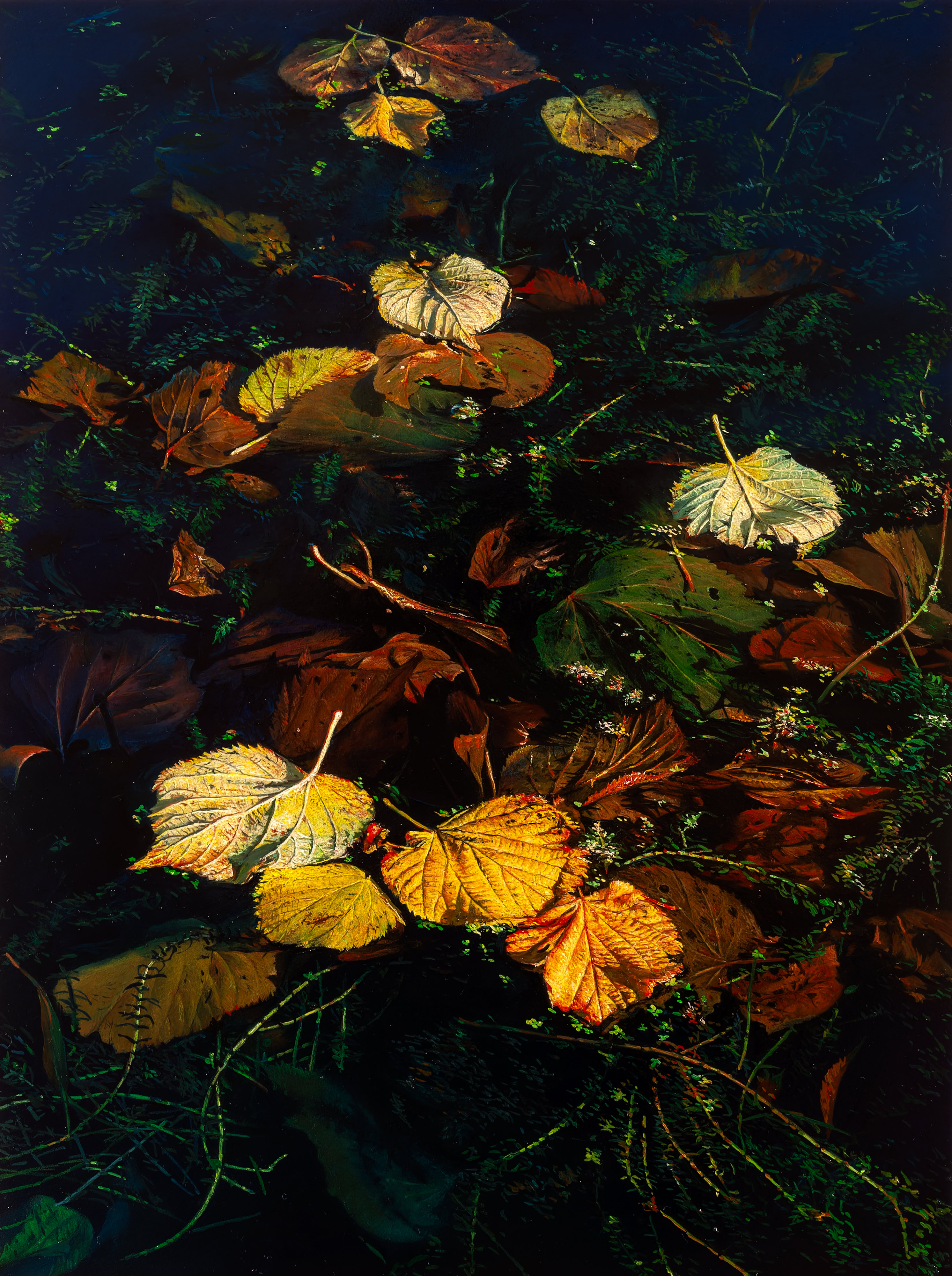
Oil on panel, 405 × 305 mm, 2026
About Leaves Floating on Water
Nietzsche wrote, “If you gaze long into an abyss, the abyss also gazes into you.”
Each time I encounter these words, I cannot help feeling that the surface of water is not merely nature’s outermost layer, but a strange place that quietly draws in one’s gaze, one’s emotions, and even one’s memories ― and returns them to us in turn.
In the Leaves Floating on Water works, I paint fallen leaves resting on the water: very quiet fragments of nature. They carry within them the sense of time passing from autumn toward winter. Alongside the signs of decline and ending, there remains a faint vestige of life ― leaves that still hold the light and linger upon the surface.
Although they are in a state of decay, they do not simply sink. Lit by the light, they seem, for a moment, to take on an expression akin to eternity.
Such images of the water’s surface call to mind, somewhere within me, Millais’s Ophelia ― the stillness of something yielding itself to the water, its beauty and its peril, the presence of life and death held in tension within a single image. No figure, of course, appears in my work. And yet, in gazing at these floating leaves, the viewer may be drawn beyond the mere form of a plant, toward lost time and memory, or toward the presence of feeling before it becomes words.
In these works, I am also conscious of a beauty of texture and matière in the surfaces of the leaves and the depth of the water, something akin to the pleasure one feels before fine craftsmanship. Though the leaf may be decaying, in its veins, in the delicate undulations of its edges, and in the texture of its skin catching the light, there seems to dwell a quiet ornamental quality.
That a refined and concentrated beauty should arise out of nature’s transience may be one of the places at which realist painting finally arrives.
The depths of the water are dark, silent, and unfathomable. When we peer into them, what we see ought to be nature; yet before we know it, we are also descending into our own inner depths. And in that moment, as Nietzsche suggests, the abyss too gazes back at us.
Realism, perhaps, is not only the precise rendering of visible form, but also an act of summoning the time, presence, and tactile beauty concealed behind the subject.
In this series, through the delicate expressions of fallen leaves floating on water, I wished to portray the quiet depth of nature, and the state of the human gaze as it stands before it.
Masayuki Hara